Law & Governance · October 2026
ESG in Kenya: From Voluntary Commitment to Legal Accountability
What every board, business and advocate needs to know before IFRS S1 and S2 reporting begins on 1 January 2027.
Belinda Wakasa, Advocate of the High Court of Kenya
Why ESG matters now
In less than three months, Environmental, Social and Governance (ESG) reporting stops being optional for Kenya's listed companies, banks, insurers, pension schemes and deposit-taking SACCOs. This article sets out what ESG is, the law that already governs it in Kenya, what the courts have said, and what boards should do before 1 January 2027.
For most of the last decade, ESG in Kenya sat in the corporate social responsibility (CSR) column: voluntary, narrative and largely unchecked. Three developments in 2025 and 2026 have changed that.
The reporting mandate. Under the Institute of Certified Public Accountants of Kenya (ICPAK) national roadmap, Public Interest Entities must publish sustainability disclosures aligned with IFRS S1 and IFRS S2 for accounting periods beginning on or after 1 January 2027, with independent assurance phased in from 2028.
The banking taxonomy. The Central Bank of Kenya (CBK) issued the Kenya Green Finance Taxonomy and a Climate Risk Disclosure Framework on 4 April 2025 for voluntary use over 18 months; application becomes mandatory for banks and mortgage finance companies from October 2026.
The capital markets code. In July 2026 the Capital Markets Authority (CMA) cleared a draft ESG Code for public consultation. Under it, boards of listed companies would take direct responsibility for ESG oversight.
The courts have moved in parallel. In the last two years, Kenyan courts have upheld a KSh 1.3 billion award for lead poisoning, confirmed the cancellation of the licence for a 1,050 MW coal plant for want of public participation, and ordered a state corporation to pay over KSh 3 billion for an oil spill. The question for an organisation is no longer whether to consider ESG. It is whether its decisions, data and disclosures can withstand regulatory and judicial scrutiny.
What ESG is, and what it is not
ESG is a framework for identifying, measuring, managing and disclosing the environmental, social and governance risks and opportunities that affect an organisation's value, and the impacts the organisation has on people and the planet. It is a risk and governance discipline, not a philanthropy budget.
| Pillar | What it covers | Typical Kenyan touchpoints |
|---|---|---|
| Environmental | Greenhouse gas emissions, energy, water, waste, pollution, biodiversity, climate risk | EIA licences, effluent and emission standards, carbon projects, extended producer responsibility |
| Social | Health and safety, working conditions, diversity and inclusion, human rights, community impact, data privacy, consumer protection | Employment Act, OSHA, Data Protection Act, community consultation, benefit sharing |
| Governance | Board oversight, ethics and anti-corruption, shareholder rights, remuneration, disclosure, internal controls | Companies Act directors' duties, CMA Code, anti-bribery procedures, audit and assurance |
Three terms are often used interchangeably but mean different things:
CSR is what a company chooses to give back: largely voluntary, qualitative and managed as brand and community relations.
Sustainability is the broader aim of creating long-term economic, environmental and social value, often described as the triple bottom line.
ESG is the measurable, disclosable and increasingly regulated way of showing how sustainability matters affect the business and how the business affects them. It is tested by evidence, audit and, now, assurance.
ESG is therefore not only about climate change, carbon trading or oil and gas emissions, and it is not a tree-planting day. A digital lender's handling of customer data, a hospital's procurement integrity and a manufacturer's supplier labour practices are all ESG issues.
Why the world moved: risk, development goals and capital
ESG rose because the risks it describes became financial. The World Economic Forum's Global Risks Report 2026, drawing on more than 1,300 experts, ranks geoeconomic confrontation first over two years, with misinformation and disinformation second. Over ten years, environmental risks dominate: extreme weather events, biodiversity loss and ecosystem collapse, and critical change to Earth systems take the top three places.
Kenya does not need a global survey to see these risks. Rising waters in Lake Naivasha have displaced communities and submerged hotels and homes, and drought, floods and supply-chain shocks now show up in loan books, insurance claims and county budgets.
Two further forces pushed ESG from the margins to the boardroom:
Development goals. The Millennium Development Goals (2000 to 2015) gave way to the 17 Sustainable Development Goals (2015 to 2030). The SDGs map directly onto ESG: clean water, energy and climate action on the environmental side; poverty, health, education and decent work on the social side; strong institutions and partnerships on governance.
Capital. Investors, development finance institutions and lenders now price ESG risk. Access to green bonds, concessional finance and foreign institutional capital increasingly depends on credible, comparable ESG data. Supply-chain history also shows the cost of ignoring it: the conflict-diamond campaigns over Sierra Leone and Liberia, and scrutiny of minerals from the eastern Democratic Republic of the Congo, were driven by stakeholders who disrupted supply chains until sourcing changed.
The global standards: who sets the rules
A standard binds an organisation only when a law, a regulator, a listing rule or a contract makes it do so. Until then, it is a method. Practitioners should keep three categories apart: voluntary frameworks an issuer chooses to use, compulsory requirements a law imposes on defined entities, and hybrid instruments that become binding through adoption or contract, such as IFRS S1 and S2 adopted by ICPAK or IFC Performance Standards written into a loan agreement.
| Framework | Issuer | Focus | Status for a Kenyan entity |
|---|---|---|---|
| IFRS S1 and S2 | International Sustainability Standards Board (ISSB), 2023 | Sustainability and climate risks that affect enterprise value | Mandatory for PIEs from 1 January 2027 under the ICPAK roadmap |
| SASB Standards | Now maintained by the ISSB | Industry-specific metrics | ICPAK directs entities to consider them when identifying metrics under IFRS S1 |
| GRI Standards | Global Reporting Initiative | An organisation's impacts on economy, environment and people | Voluntary; the basis of the NSE ESG Disclosures Guidance Manual (2021) |
| TCFD | Task Force on Climate-related Financial Disclosures, 2017 | Climate governance, strategy, risk, metrics | Disbanded in 2023; its structure lives on in IFRS S2 |
| TNFD | Taskforce on Nature-related Financial Disclosures, 2023 | Nature and biodiversity | Voluntary |
| GHG Protocol | WRI and WBCSD | Method for measuring Scope 1, 2 and 3 emissions | Required in effect, because IFRS S2 requires Scope 1, 2 and 3 disclosure |
| IFC Performance Standards | International Finance Corporation, 2012 | Environmental and social risk in projects | Binding by contract on IFC-financed clients |
Materiality: single or double
Materiality decides what gets reported. The ISSB uses financial materiality: how sustainability matters affect the company's cash flows, access to finance and cost of capital. The EU uses double materiality: that question, plus how the company's activities affect people and the environment. A durable business needs both views. Kenya has adopted the ISSB baseline, while the NSE manual's GRI roots and Kenya's constitutional environmental rights keep impact firmly in view.
What is happening abroad
European Union. The Omnibus I package, finally approved by the Council on 24 February 2026, narrowed the Corporate Sustainability Reporting Directive to companies with more than 1,000 employees and over EUR 450 million turnover, and the due diligence directive to companies with more than 5,000 employees and EUR 1.5 billion turnover. Non-EU groups with more than EUR 450 million EU turnover remain in scope from financial year 2028.
United Kingdom. On 30 September 2026 the Financial Conduct Authority published PS26/19, requiring listed companies to report against the UK Sustainability Reporting Standards, the UK-endorsed version of IFRS S1 and S2, on a comply-or-explain basis for periods beginning on or after 1 January 2027.
The lesson for Kenya. Scope has been trimmed in Europe, but the direction is settled: ISSB-based reporting is becoming the global baseline. Kenyan exporters and subsidiaries of European groups will still receive data requests from customers and parents.
Kenya's legal framework: ESG is already law
Kenya has no single ESG statute, and it does not need one to make ESG enforceable. The obligations are spread across the Constitution, sector statutes, regulatory codes and standards that become binding when adopted or contracted.
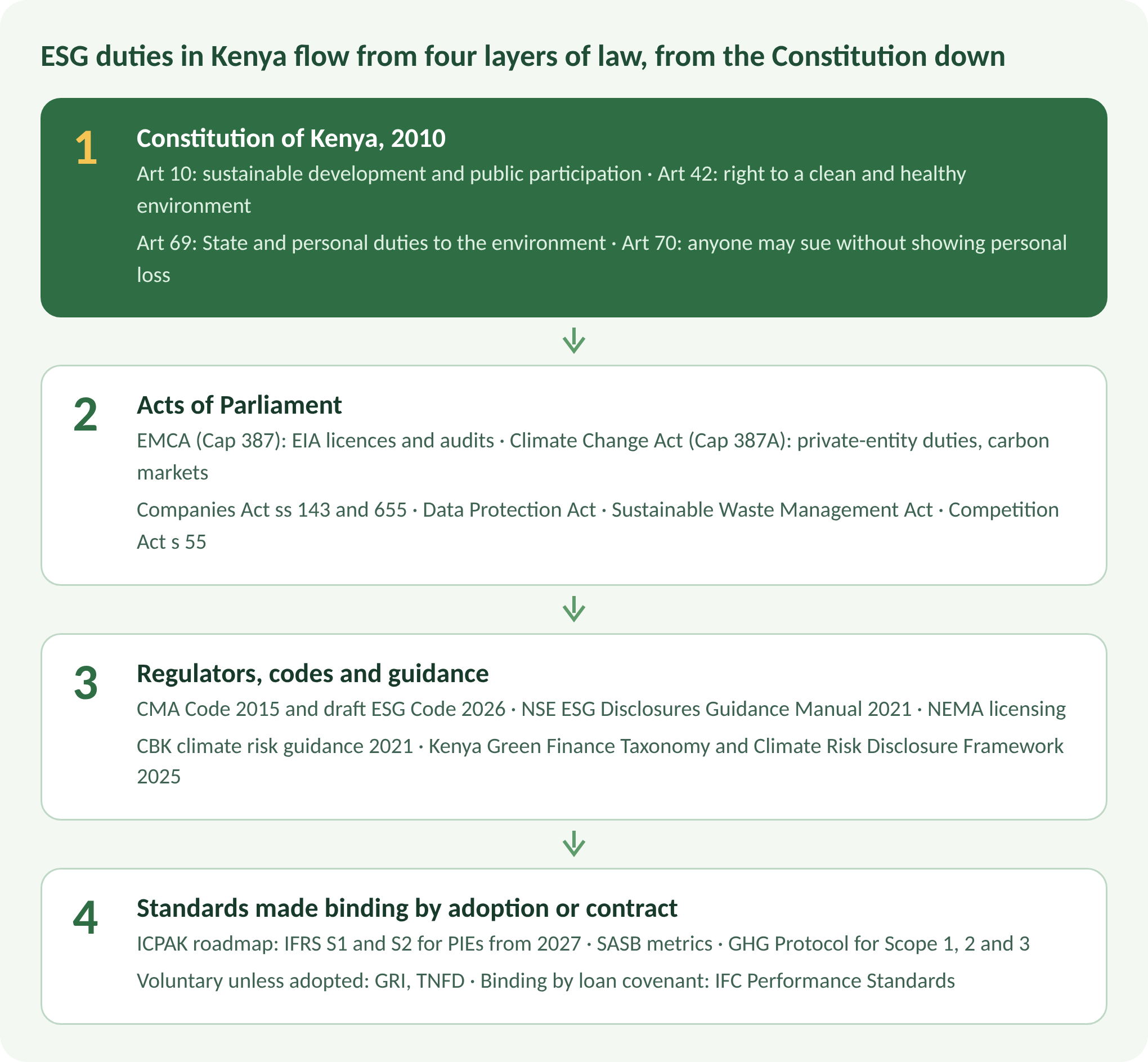
The Constitution sits on top: a company that pollutes, excludes communities from decisions or misrepresents its impact can face a constitutional petition, not only a regulatory fine.
| Instrument | Key provision | Who it bites |
|---|---|---|
| Constitution of Kenya, 2010 | Art 10 (sustainable development, public participation); Art 42 (clean and healthy environment); Art 69 (duties relating to the environment); Art 70 (enforcement; no need to show loss) | Everyone, including the State and its regulators |
| Environmental Management and Co-ordination Act (Cap 387) | Environmental impact assessment licence before a project starts; environmental audits; polluter-pays and precautionary principles | Project proponents, NEMA |
| Climate Change Act (Cap 387A) | s 16: the National Climate Change Council may impose climate change duties on private entities. The 2023 amendment and the Climate Change (Carbon Markets) Regulations, 2024 require community development agreements and annual social contributions of at least 40% (land-based) or 25% (non-land-based) of aggregate earnings for projects on public or community land | Carbon project developers; large emitters |
| Companies Act (Cap 486) | s 143: directors must have regard to, among other things, the impact of operations on the community and the environment. s 655(4): a quoted company's business review must cover environmental matters, employees, and social and community issues | All directors; quoted companies |
| CMA Code of Corporate Governance Practices for Issuers of Securities to the Public, 2015; draft ESG Code, 2026 | Governance standards on an apply-or-explain basis; the draft code makes boards responsible for integrating ESG into strategy, risk, remuneration, stakeholder engagement and disclosure | Listed issuers |
| NSE ESG Disclosures Guidance Manual (November 2021) | GRI-aligned guidance for annual ESG reporting; not yet mandated by the exchange | Listed issuers |
| CBK Guidance on Climate-Related Risk Management (October 2021); Kenya Green Finance Taxonomy and Climate Risk Disclosure Framework (April 2025) | Climate risk in governance, strategy, risk management and disclosure; taxonomy mandatory from October 2026 after an 18-month voluntary period | Banks and mortgage finance companies, and through them their borrowers |
| ICPAK roadmap for IFRS S1 and S2 | Phased mandatory adoption, readiness assessment and assurance (next section) | PIEs, then large entities, then SMEs |
| Sustainable Waste Management Act, 2022; EPR Regulations, 2024 (LN 176 of 2024) | Producers register with NEMA, run take-back schemes, pay EPR fees and report annually | Manufacturers, importers, brand owners |
| Data Protection Act, 2019 | Lawful processing and data-subject rights | Any entity handling personal data |
| Competition Act, 2010, s 55 | Prohibits false or misleading representations about goods and services | Any business making green or social claims |
| National Action Plan on Business and Human Rights (2019) | Domesticates the UN Guiding Principles; themes include land, labour, revenue transparency, environment and access to remedy | Private businesses and state-owned enterprises |
Employment, occupational safety and health, anti-bribery and public procurement law complete the social and governance pillars. For most organisations, the ESG gap is not a missing law; it is the missing evidence that existing law is being complied with.
Kenya's reporting clock
ICPAK announced its intention to adopt IFRS S1 and S2 on 6 September 2023 and launched a phased national roadmap in late 2024. Its advisory on timelines and readiness confirms that the roadmap remains on course: Public Interest Entities report for accounting periods beginning on or after 1 January 2027.
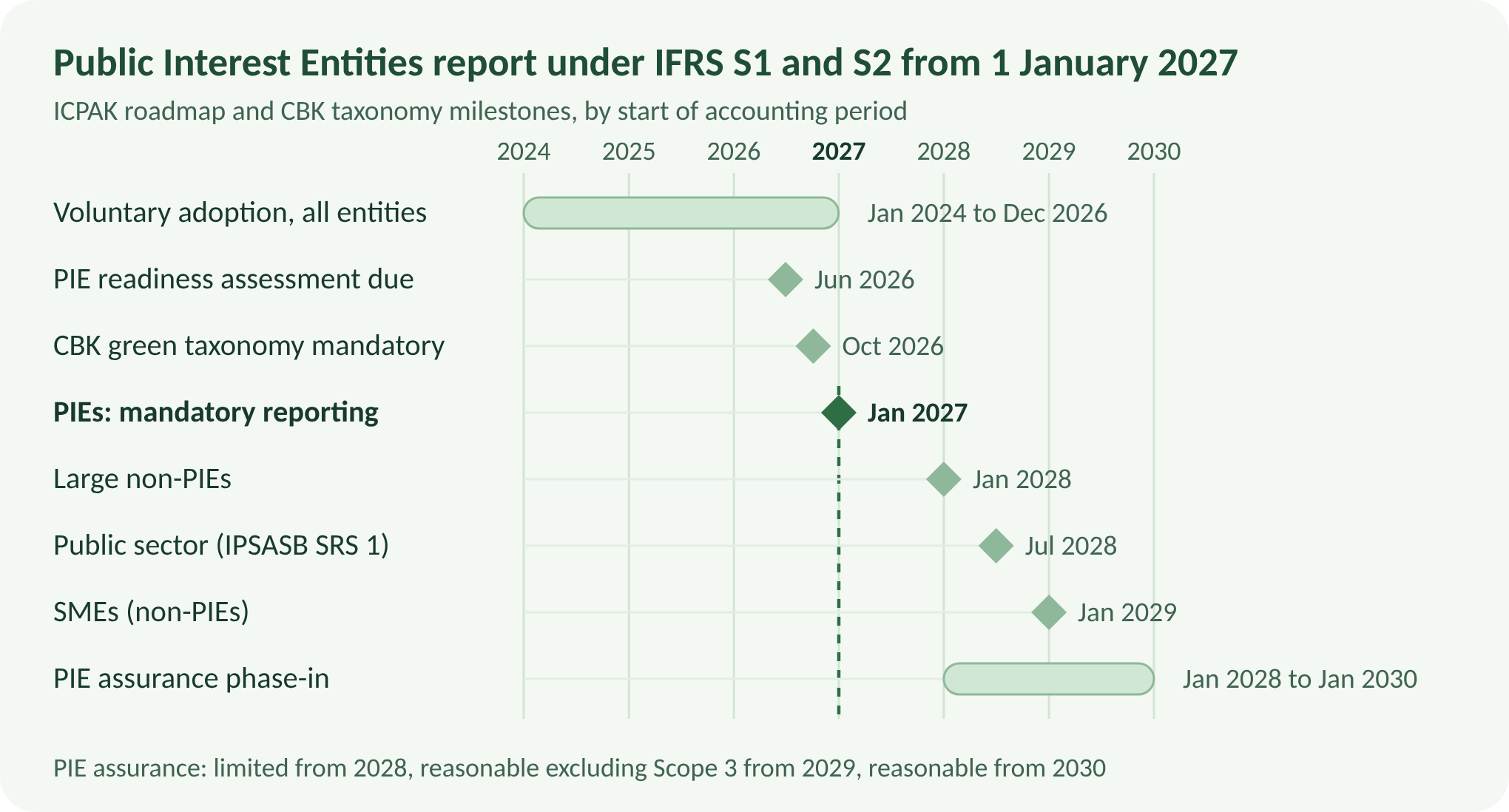
Who is a Public Interest Entity? ICPAK lists companies listed on the NSE; CBK-regulated commercial banks; IRA-regulated insurers; RBA-regulated retirement benefit schemes; CMA-regulated fund managers and collective investment schemes; SASRA-regulated deposit-taking SACCOs; and large state corporations reporting under IFRS.
Who is a large non-PIE? An entity that exceeds two of three thresholds: annual turnover above KES 100 million, total assets above KES 250 million, or more than 250 employees. ICPAK urges entities with turnover above KES 1.3 billion to start early.
| Phase | Reporting from (periods beginning) | Limited assurance | Reasonable assurance, excluding Scope 3 | Reasonable assurance |
|---|---|---|---|---|
| Public Interest Entities | 1 January 2027 | 1 January 2028 | 1 January 2029 | 1 January 2030 |
| Large non-PIEs | 1 January 2028 | 1 January 2029 | 1 January 2030 | 1 January 2031 |
| SMEs (non-PIEs) | 1 January 2029 | 1 January 2030 | 1 January 2031 | 1 January 2032 |
| Government organisations (IPSASB SRS 1) | 1 July 2028 | 1 July 2030 | 1 July 2031 | 1 July 2032 |
The advisory adds five practical requirements:
Readiness assessment. Every PIE must submit a Sustainability Reporting Readiness Assessment to ICPAK, covering governance, strategy, risk management, and metrics and targets, six months before its first mandatory reporting period.
Assurance. Assurance must be given by an ICPAK-licensed practitioner holding a Category A or Category C licence and sustainability accreditation, independent under the IESBA Code. ICPAK suggested PIEs engage a provider by 30 June 2026.
Emissions. IFRS S2 requires Scope 1, 2 and 3 greenhouse gas emissions, using recognised emission factors such as IPCC, IEA or DEFRA where local factors are unavailable.
Connectivity. Sustainability disclosures must be consistent with the financial statements and management commentary, and show how sustainability affects strategy, capital allocation and financial position.
Board accountability. Boards and audit committees are expected to take direct accountability; board sign-off on first-year disclosures will be a key indicator in ICPAK's review. ICPAK will coordinate enforcement with the CMA, CBK, IRA, SASRA and RBA.
One caution from the conference floor: a closing slide described ESG as "voluntary and not compelled". That remains true for GRI-style reporting and CSR, but not for IFRS S1 and S2 reporting by PIEs from 2027, nor for the CBK taxonomy for banks from October 2026.
ESG in the courts: three Kenyan lessons
Kenyan courts have turned environmental and social failures into liabilities measured in billions of shillings, and they have held regulators to account alongside companies.
| Case | Court and date | Outcome | Lesson |
|---|---|---|---|
| Kimeu & 3074 others v Kenya Pipeline Company Ltd & another (Environment and Land Petition 9 of 2019 & Petition 8 & 12 of 2019 (Consolidated)) [2025] KEELC 5239 (KLR) | Environment and Land Court, Makueni, 11 July 2025 | A corroded pipeline leaked into the Thange River basin on 12 May 2015. The court found KPC and NEMA liable, reportedly apportioning 80% to KPC and 20% to NEMA, awarded about KSh 2.12 billion to 3,075 petitioners, and ordered restoration within 120 days or KSh 900 million to NEMA for the clean-up. It rejected earlier discharge vouchers as adequate compensation | Restoration is a direct liability, and early, under-valued settlements will not shield a polluter. Execution was still being contested in late 2025 |
| Amu Power Company Limited v Save Lamu & 6 others (Environment and Land Appeal 6 of 2019) [2025] KEELC 7285 (KLR) | National Environment Tribunal (Appeal No. 196 of 2016), 26 June 2019; Environment and Land Court, Malindi, 16 October 2025 | The Tribunal cancelled NEMA's EIA licence for the 1,050 MW Lamu coal plant because public participation was not meaningful and the assessment was incomplete, including on climate change. The ELC dismissed Amu Power's appeal | Stakeholder engagement is a legal condition, not a procedural formality. A licence obtained without it can be lost years later |
| The Owino Uhuru case: Petition E021 of 2023 [2024] KESC 75 (KLR) (reported on Kenya Law under the title beginning "Export Processing Zone Authority & 10 others") | Environment and Land Court, Mombasa, 2020; Court of Appeal, June 2023; Supreme Court, 6 December 2024 | A lead-acid battery recycler poisoned residents of Owino Uhuru village in Mombasa. The ELC awarded KSh 1.3 billion and ordered a clean-up. The Court of Appeal set the award aside and remitted assessment of damages. The Supreme Court reinstated the award, agreeing that NEMA bore greater responsibility | Regulators who license and fail to supervise share liability. The polluter-pays principle reaches the whole chain of approval |
Three themes run through these decisions. First, Article 70 of the Constitution lets communities sue without proving personal loss, so the litigation risk is real and collective. Second, courts look at the quality of consultation, not just whether a meeting took place. Third, liability attaches to boards' decisions years after the event: the Thange spill was in 2015 and the judgment came in 2025.
For a board, the test before approving a major decision is whether it can later demonstrate that the decision was responsible, informed and defensible: that it considered environmental impact, identified affected stakeholders, consulted them properly, held evidence for its ESG claims and assessed the litigation risk.
ESG governance in practice
Good ESG governance makes sustainability part of how decisions are taken, funded and evidenced. The tone is set at board level and cascaded through operations and the supply chain. It works through seven pillars:
Board oversight and committee structure: a named committee or the full board owns ESG, with it on the agenda and in the charter.
Management execution: accountable executives and teams with budgets.
Performance measurement and reporting: defined metrics, baselines and reporting periods.
Risk management integration: ESG risks inside the enterprise risk register, not beside it.
Policies and charters: environmental, human rights, procurement, data and anti-bribery policies that match practice.
Stakeholder engagement: documented consultation with communities, staff, customers and investors, with a working grievance mechanism.
Audit and assurance: internal testing first, then independent assurance.
The ESG assurance register
Compliance is often punctuated: it peaks at licensing, financing or audit, and gaps open between policy and delivery in between. An assurance register closes those gaps. For every material obligation, it records:
the obligation and its legal basis (statute, licence condition, loan covenant or board policy);
the control that delivers it, its owner and its budget;
the evidence, the key performance indicator and the next review date; and
exceptions, the remedial action and its closure.
The evidence ladder
A claim is only as strong as the evidence behind it. Grading each register entry shows the board where its disclosures are exposed.
| Level | Standard of evidence | Example |
|---|---|---|
| A1 Assertion | A management statement | "We treat effluent before discharge" |
| A2 Documented | Policies and records exist | An effluent management procedure and licence |
| A3 Implemented | Operational evidence | Monthly laboratory results and discharge logs |
| A4 Tested | Sampled or recalculated internally | Internal audit re-performs a sample of results |
| A5 Assured | Independently verified | Limited or reasonable assurance by a licensed practitioner |
A simple prioritisation helps: score each duty on likelihood of failure, impact and weakness of evidence, and deal first with weak evidence on serious duties. Scores support professional judgement; they do not replace it.
Useful indicators for board reporting include the share of duties with a named owner, licences and permits current, high-risk duties with tested evidence, required activities that are funded, and the number and age of overdue actions.
Myths and pitfalls
Greenwashing. Labels such as "eco", "natural" or "carbon neutral" without evidence are misleading representations. Section 55 of the Competition Act, 2010 already prohibits false or misleading representations about goods and services, and the Competition Authority has used it against misleading claims. Under IFRS S1 and S2, an unsupported claim becomes a misstatement in a document the board signs.
"Explain" as a shield. Apply-or-explain codes allow a reasoned departure from a recommendation. An explanation cannot cure a breach of mandatory law, a licence condition or a disclosure standard that has been adopted.
Exaggerated or unvalidated data. Most first-year failures will be data failures: no owner, no baseline, Scope 3 estimates nobody can trace, and figures that do not reconcile to the financial statements. You cannot govern what you cannot measure, or credibly disclose what you cannot evidence.
Boilerplate. ICPAK has asked for concise, decision-useful reports and warned against length and generic statements. A long sustainability report is not a better one.
Aspirational targets. Net-zero pledges and community commitments without an implementation plan, budget and owner create exposure, not credit.
"ESG is for listed companies." Banks must classify lending against the green taxonomy, and listed customers will ask suppliers for data. Private companies, SMEs and county-level contractors will feel ESG through their lenders and buyers before any reporting rule reaches them.
Treating standards as law, or law as optional. GRI and TNFD remain voluntary unless adopted; IFRS S1 and S2 are mandatory for PIEs from 2027. Confusing the two produces either needless cost or real breach.
What boards should do before 1 January 2027
Confirm your category. Establish whether the entity is a PIE, a large non-PIE or an SME under the ICPAK roadmap, and whether a lender, parent company or customer imposes ESG terms by contract.
Assign ownership. Give a board committee written responsibility for sustainability, update its charter, and name an accountable executive.
Map obligations. Build an assurance register of the entity's ESG duties under the Constitution, EMCA and licence conditions, the Climate Change Act, the Companies Act, sector regulation and financing documents.
Run a materiality assessment. Identify the five or six sustainability issues that most affect enterprise value and stakeholders, using SASB industry metrics as ICPAK suggests.
Fix the data. Set baselines, owners and controls for emissions and other key metrics, and reconcile them to the financial statements.
Integrate risk. Bring climate and social risks into the enterprise risk register, with scenario analysis where IFRS S2 requires it.
Engage the assurance provider early, and dry-run a disclosure against IFRS S1 and S2 with a content index.
Review claims. Test every public sustainability statement, product label and investor presentation against the evidence before it is repeated.
Where advocates add value
ESG is a legal discipline as much as an accounting one. Lawyers are needed to:
map obligations and gaps across law, licences, contracts and policy;
design assurance registers and board governance structures;
review disclosures and marketing claims for greenwashing and misstatement risk;
draft and negotiate ESG covenants, sustainability-linked loan terms, supplier codes and community development agreements for carbon projects;
advise on public participation and EIA processes before licences are challenged; and
defend or bring environmental and human rights petitions under Articles 42 and 70.
Each engagement should define its scope, fees and the responsibilities of other specialists, such as accountants, engineers and environmental experts. Legal advice on what the law requires, and on what can safely be said in public, is the part that only an advocate can give.
Conclusion
ESG in Kenya has moved from voluntary commitment to legal accountability. The constitutional and statutory duties have existed for years; what is new is the obligation to measure them, disclose them, have them assured and defend them before regulators, investors and courts.
The organisations that will do well are not those with the longest sustainability reports. They are those whose boards know their material issues, whose data can be traced, whose claims can be proved, and whose communities were genuinely heard. That is good governance, and it is also what attracts responsible capital.
This article is for general information and does not constitute legal advice. Organisations should take advice on their specific obligations.
References
Constitution and statutes
Constitution of Kenya, 2010, Articles 10, 42, 69 and 70
Environmental Management and Co-ordination Act (Cap 387)
Climate Change Act (Cap 387A), as amended by the Climate Change (Amendment) Act, 2023; Climate Change (Carbon Markets) Regulations, 2024
Companies Act (Cap 486), sections 143 and 655
Competition Act, 2010, section 55
Data Protection Act, 2019
Sustainable Waste Management Act, 2022; Sustainable Waste Management (Extended Producer Responsibility) Regulations, 2024, Legal Notice 176 of 2024
Cases
Save Lamu & 5 others v National Environmental Management Authority & Amu Power Co. Ltd, National Environment Tribunal Appeal No. 196 of 2016 (26 June 2019)
Regulatory instruments and guidance
ICPAK, Advisory on timelines and readiness requirements for IFRS S1 and IFRS S2; Roadmap for the adoption of IFRS Sustainability Disclosure Standards in Kenya
Central Bank of Kenya, press release on the Kenya Green Finance Taxonomy and Climate Risk Disclosure Framework; CBK Guidance on Climate-Related Risk Management (October 2021)
Capital Markets Authority, Code of Corporate Governance Practices for Issuers of Securities to the Public, 2015; CMA draft ESG Code, reported by The Star, 13 July 2026
Nairobi Securities Exchange, ESG Disclosures Guidance Manual (November 2021)
Kenya National Action Plan on Business and Human Rights (June 2019)
International standards and developments
IFRS Foundation, IFRS S1 General Requirements for Disclosure of Sustainability-related Financial Information and IFRS S2 Climate-related Disclosures (2023)
EU Omnibus I: final adoption of amendments to the CSRD and CSDDD (24 February 2026)
Case reporting
Conference sources: Patricia Kiwanuka, "ESG in Practice" (Revenu Stream Ltd, 9 October 2026); Desmond Tutu Owuoth, "Navigating Punctuated ESG Compliance and Transition Roadmaps" (LSK CPD, October 2026).